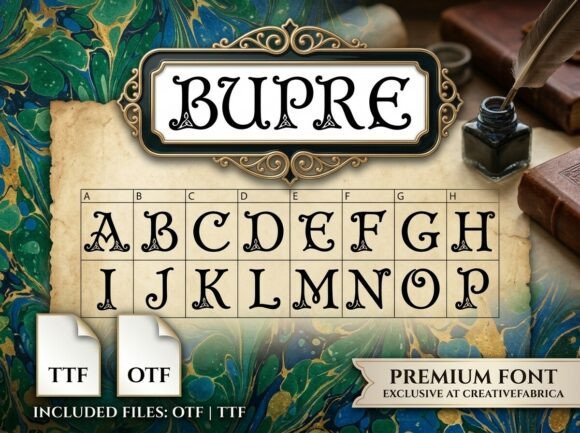
Bupre: A Modern Serif for Mythic Branding
When a project demands a voice that feels both ancient and authoritative, standard typography often falls short. You need a typeface that carries weight, history, and a distinct personality. Enter Bupre, a premium font designed to bridge the gap between historical insular script and contemporary fantasy aesthetics. It’s not just a collection of letters; it’s a design asset built for narrative and impact.
Unpacking the Visual Soul of Bupre
At its core, Bupre is a bold, high-contrast display serif. Its heavy structural weight immediately commands attention, making it ideal for headlines and logos where presence is non-negotiable. What truly sets this serif font apart, however, are its details. The letterforms are characterized by rhythmic, hand-drawn terminals that echo the intricate beauty of Celtic knotwork. You’ll notice subtle triquetra-inspired flourishes woven into the strokes, giving each character a crafted, almost talismanic quality.
This isn’t a simple revival of medieval script. The design balances that "mythic-and-monumental" soul with the clean geometry needed for modern logo design and editorial design. The result is a typeface that feels legendary without sacrificing the clarity required for effective brand identity. It’s a creative font that tells a story before the reader even processes the words.
Where Bupre Finds Its Home: Practical Applications
Choosing the right display font is about matching personality to purpose. Bupre thrives in niches where heritage, craftsmanship, and a touch of the fantastical are central themes. For designers and entrepreneurs, here’s where this typeface truly shines:
- Artisanal & Craft Branding: Think independent mead labels, craft breweries, or boutique bakeries. Bupre’s hand-crafted aesthetic communicates authenticity and small-batch quality instantly. It works beautifully on packaging design, labels, and bottle neckers.
- Tabletop RPG & Gaming: For publishers of sourcebooks, character sheets, or fantasy maps, Bupre provides the perfect "folkloric-and-formidable" tone. Its legibility at larger sizes makes it excellent for chapter headings and cover art in publishing.
- Heritage & Fantasy Apparel: On t-shirts, hoodies, and merchandise, this typeface creates standout graphics. It’s ideal for band merch, historical reenactment gear, or any apparel line drawing from Celtic, Norse, or general fantasy motifs.
- Digital & Social Media: In the fast-scrolling world of social media, a high-impact header is crucial. Bupre’s bold weight ensures your message is seen. Use it for YouTube thumbnails, Instagram story headers, or podcast cover art to establish a strong, recognizable visual hook.
Strategic Typography: How Bupre Influences Perception
A font does more than display text; it shapes how an audience feels about your content. Integrating Bupre into your brand identity can influence several key areas of your design strategy:
- Visual Hierarchy & Readability: As a display font, Bupre is engineered for impact, not for body copy. Use it to create a clear hierarchy. Pair it with a clean, neutral sans serif font or a simple script font for body text. This contrast ensures your headlines pop while your paragraphs remain easy to read.
- Brand Recognition: The unique Celtic-inspired terminals are highly distinctive. When used consistently across social media graphics, website headers, and print materials, Bupre helps build immediate visual recognition. Customers will start to associate that specific, intricate style with your brand’s story.
- Professionalism & Trust: In specialized markets, generic fonts can make a brand feel amateurish. A well-chosen commercial font like Bupre signals investment and attention to detail. It tells your audience you care about the craft, which builds trust—especially in industries like artisanal goods or publishing.
A Designer’s Guide to Working with Bupre
Ready to put Bupre to work? Here are some practical considerations for designers, marketers, and content creators to ensure a smooth workflow and a polished final product.
Evaluating the Fit: Before committing, ask if the project’s narrative aligns with Bupre’s personality. Is the goal to evoke history, fantasy, or handcrafted tradition? If the answer is yes, it’s likely a strong candidate. If the project is ultra-modern or minimalist, you might explore other modern typography options.
Testing Font Pairings: Bupre’s complexity means it pairs best with simplicity. A geometric sans serif font like Montserrat or Lato for body text creates a clean, readable foundation that lets Bupre’s details stand out. For a more thematic pairing, a subtle handwritten font can complement its artisanal feel, but use this combination sparingly to avoid visual clutter.
Reviewing the Styles: Check the font package for included styles. Does it have multiple weights (Regular, Bold, Black)? Are there italics or alternate characters? These variations give you flexibility to create nuanced visual hierarchy within your designs without needing additional typefaces.
Readability at Scale: Always test Bupre at the intended size. Its intricate terminals are a feature at large scales but can become noise if the font is reduced too small. For web design, ensure your headline sizes are large enough to showcase its character. For print design, a test print is invaluable.
Licensing for Commercial Use: If you’re using Bupre for client work, merchandise, or any commercial product, verify the licensing. A commercial font license ensures you have the legal right to use the font across all your intended applications, protecting both you and your clients.
Ultimately, Bupre is more than a design asset